
Palestine Islamic Bank and An-Najah National University Conclude the “Waed” Training Program
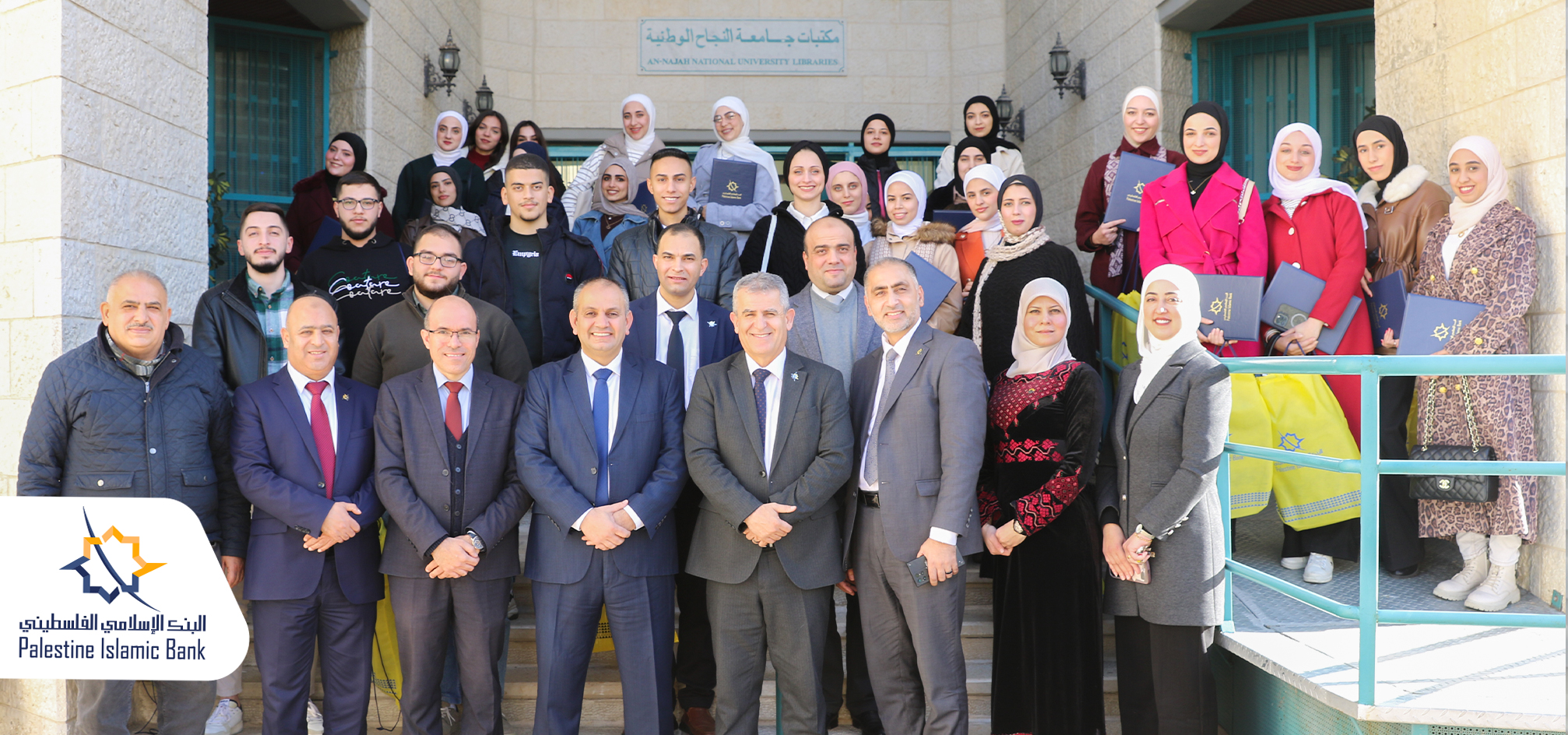
Palestine Islamic Bank and the Faculty of Business and Communication at An-Najah National University concluded the specialized “Waed” training program, in which 33 male and female students from the faculty participated. The program was delivered by a group of the Bank’s managers and aimed at training participating students, preparing them for entry into the labor market, and enhancing their professional readiness for the banking sector.
The graduation ceremony for the program participants was held on the campus of An-Najah National University, attended by the General Manager of Palestine Islamic Bank, Dr. Imad Al-Sadi; the Chairman of the Bank’s Sharia Supervisory Board, Dr. Alaa Razia; the Dean of the Faculty of Business and Communication, Dr. Raafat Al-Jallad; along with a number of PIB managers and members of the faculty’s academic staff.
The program comprised 10 intensive training sessions covering a wide range of topics that contribute to developing the skills required in the banking sector. Special emphasis was placed on the concepts and applications of Islamic banking. Students received both practical and theoretical training covering the banking work environment, mechanisms for delivering banking services, communication skills, cybersecurity, compliance, marketing and sales skills, the importance of human capital, as well as an introduction to Sharia-compliant financial products.
Dr. Imad Al-Sadi, General Manager of PIB, stated that the program falls within the Bank’s commitment to its social role and its keenness to invest in youth by empowering university students to acquire practical skills that qualify them to engage efficiently in the banking labor market, particularly in the field of Islamic banking.
Dr. Al-Sadi added: “The ‘Waed’ program and other training initiatives we implement align with our strategic plan, which places great emphasis on youth empowerment, support for applied education, and knowledge dissemination. Our role is not limited to providing banking services or achieving financial sustainability; it also extends to making an active contribution to preparing qualified national cadres capable of contributing to the development of vital sectors, in addition to building effective partnerships with Palestinian academic institutions.”
He also commended the efforts of the Faculty of Business and Communication at An-Najah National University in ensuring the success of the training program, noting that the partnership between PIB and An-Najah represents a model to be emulated in cooperation between academic institutions and the banking sector.
From his side, Dr. Alaa Razia, PIB's Chairman of the Sharia Supervisory Board, stated that the “Waed” program contributes to enhancing students’ knowledge of Islamic banking in Palestine, its principles, and the key products and services it offers, by linking the academic aspect with practical application in a real banking environment. He emphasized the importance of the topics addressed by the program in preparing students to compete for available opportunities and integrate into the labor market.
Dr. Raafat Al-Jallad emphasized the importance of launching such training programs by the Faculty of Business and Communication, given their pivotal role in broadening students’ professional horizons and enabling them to gain direct exposure to practical experiences within leading national banking institutions. This, he noted, enhances their readiness and competitiveness in the labor market. He added that these programs constitute a fundamental pillar of the Faculty’s vision to equip graduates with professional competence and the ability to keep pace with the evolving requirements of the labor market.
Dr. Al-Jallad also praised the partnership with Palestine Islamic Bank, expressing his thanks and appreciation to the Bank’s management and staff for their outstanding efforts in ensuring the success of the “Waed” program. He affirmed that this partnership aligns with the University’s vision of building genuine strategic partnerships with effective national institutions. He added that the program represents a practical model for linking academic knowledge with field application through its specialized training topics, which reflect the essence of modern banking and contribute to preparing qualified banking professionals for the future.